
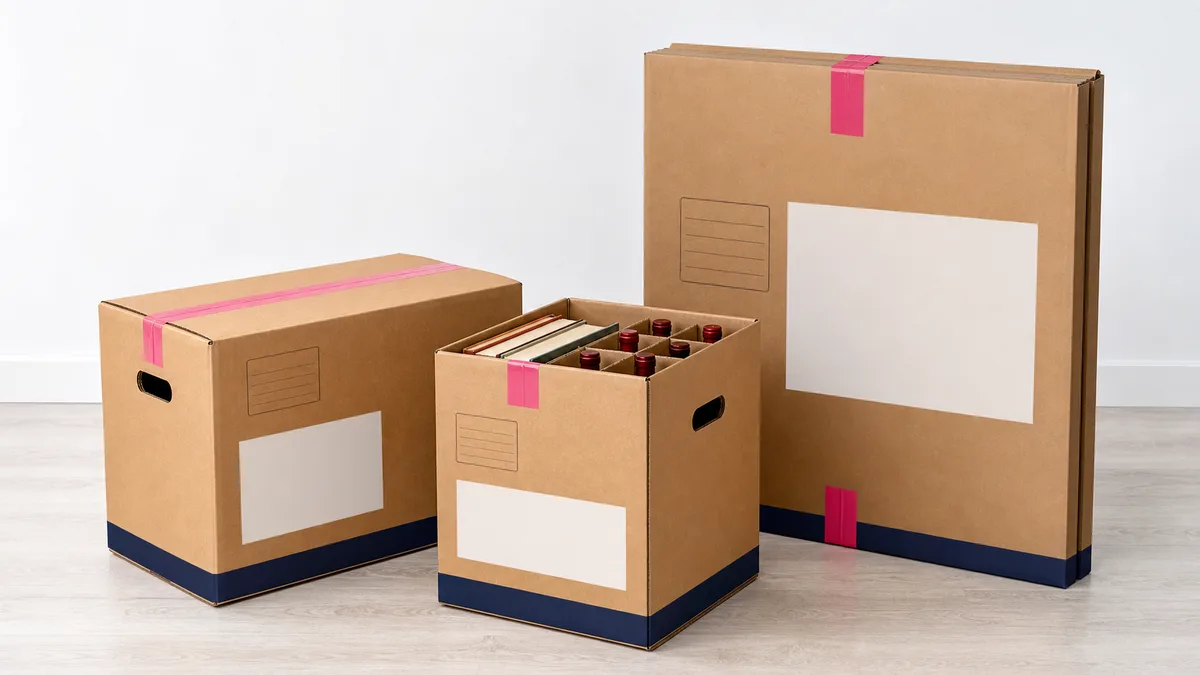
Choose a carton by what it needs to carry
The safest carton is not always the biggest. Dense items become difficult to lift in a large box, while light bulky items need enough room to avoid being crushed.
Common removal carton sizes
| Carton | Approximate dimensions | Good for |
|---|---|---|
| Book or wine carton | 40.6 × 29.8 × 43 cm | Books, records, magazines and other small dense items |
| Standard removalist carton | 40.6 × 43.1 × 59.6 cm | Clothes, toys, kitchenware and lighter mixed household goods |
| Picture or mirror carton | 104 × 77.5 × 7.5 cm | Framed pictures, mirrors and flat fragile items |
Carton dimensions vary by supplier. Measure valuable or unusually shaped items before buying materials.
Pack cartons so they can be handled and stacked
- Put heavy items in small cartons and keep the weight manageable.
- Use lighter items in larger cartons and fill empty space so the sides do not collapse.
- Keep fragile items separated and cushioned rather than relying on a fragile label alone.
- Label the destination room and a short description on the top and side.
- Keep medication, keys, chargers and essential paperwork with you.
Estimate carton quantity carefully
The Australian Furniture Removers Association's recommended packing scale uses about 1.5 standard cartons per cubic metre for an average pack and 2 cartons per cubic metre for an above-average pack. Treat that as an industry planning allowance, not a promise about your home.
Moving carton questions
Should books go in a large moving carton?
No. Books, records, tools and other dense items are better in a smaller book or wine carton so the packed box remains manageable and the base is less likely to fail.
How full should a moving carton be?
Fill voids so items do not move and the carton can be stacked, but do not overload it. Use crushed paper or linen for light void filling and keep heavy items low.
How many cartons will I need?
It depends on the household and how densely it is packed. AFRA industry guidance uses about 1.5 standard cartons per cubic metre for an average pack as a planning allowance, not a guarantee.